Next-generation tools under active development in the WayScience organization,
forming the foundation of the Cytomining roadmap.
Focused development initiative
For the detailed implementation plan focused on OME-Arrow, single-cell scale efficiency, and AI-ready workflows, see the AI-ready infrastructure initiative below.
What gaps do our experimental tools address?
The current Cytomining stack was designed around 2D single-cell data from CellProfiler.
As the field moves toward 3D organoid imaging, single-cell profiling, larger-scale screens, and deep learning feature extraction,
several gaps have emerged: no standardized image catalog, images and features stored separately, limited 3D support, and hit calling that collapses single-cell heterogeneity.
We are building the tools below to close each of these gaps and raise the computational pipeline to support the demands of data collection and goals of the moment.
Experimental tools
These tools are under active development in the WayScience organization.
For production-ready tools, see the Tools page.
Data cataloging — scans bioimaging stores and publishes image metadata to Cytomining-compatible Parquet warehouses via Apache Iceberg.
Problem: Raw bioimaging archives have no standard catalog — finding, versioning, and joining images to downstream data requires bespoke scripts per lab.
Image storage — stores microscopy images alongside metadata and derived data in a unified, queryable Apache Arrow format.
Problem: Images and feature tables live in separate systems — linking a numeric outlier back to its source cell requires error-prone manual joins across formats.
Yellow = new 3D-capable step. Purple = new data infrastructure. Blue = existing Cytomining tools.
Focused development initiative
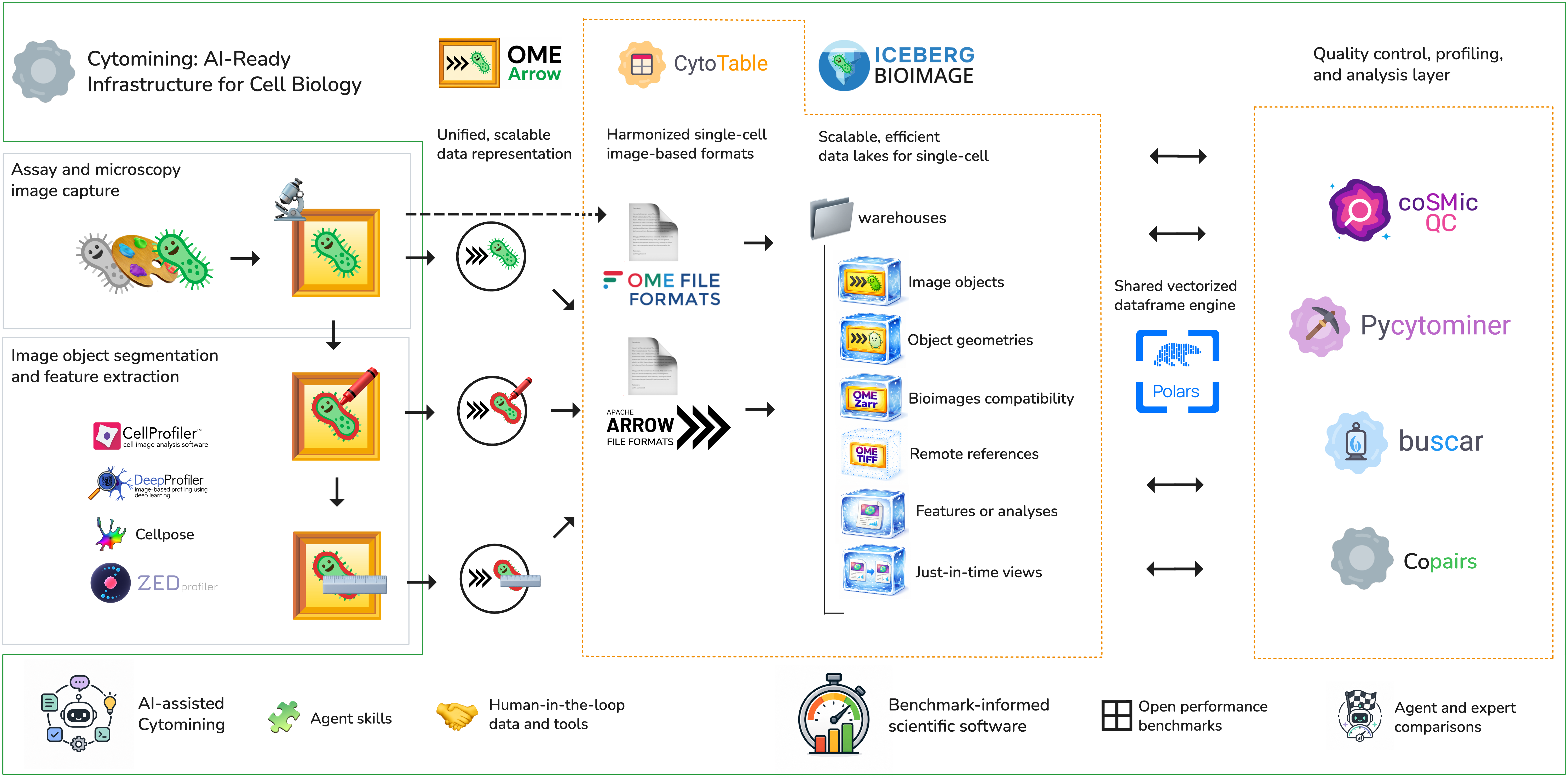
This initiative defines the next phase of Cytomining infrastructure work: unified multimodal data, efficient single-cell scale processing, and AI-ready image-based profiling.
The work connects three streams: OME-Arrow for unified multimodal data representation, Polars and iceberg-bioimage for scalable single-cell data access, and typed APIs plus agent skills for AI-ready workflows with human-in-the-loop checkpoints.
Future-state Cytomining infrastructure: image capture and feature extraction flow into OME-Arrow representations, CytoTable harmonizes single-cell formats, iceberg-bioimage organizes scalable warehouses, Polars provides a shared dataframe engine, and downstream tools support QC, profiling, and analysis.
Why this work matters
Cytomining tools already support high-content microscopy workflows, but the surrounding data infrastructure still creates friction for large, single-cell image-based profiling projects.
Images, profiles, segmentation geometries, and QC annotations often live in separate files or stores.
Large single-cell datasets are difficult to query lazily across plates, projects, and public reference collections.
Workflow expertise is distributed across documentation, notebooks, and maintainer knowledge rather than encoded as typed APIs and reusable agent guidance.
Roadmap summary
Component 1
Unified multimodal data infrastructure
Integrate OME-Arrow across the Cytomining stack so microscopy images, segmentation geometries, morphology profiles, metadata, and QC annotations share a schema-enforced data model.
Native OME-Arrow read/write support in CytoTable.
Pycytominer and coSMicQC operation on OME-Arrow datasets.
Documentation, tutorials, and OME community specification work.
Component 2
Single-cell scale efficiency
Make Cytomining workflows efficient at population scale through lazy queries, faster dataframe execution, versioned bioimage catalogs, and release-indexed benchmarks.
Polars integration across Cytomining tools.
Benchmarking across AnnData, Zarr, CSV, SQLite, Parquet, DuckDB, Lance, and related approaches.
iceberg-bioimage support for FAIR, cloud-ready, version-controlled warehouses.
Component 3
AI-ready image-based profiling
Make Cytomining workflows executable by both researchers and code-writing agents through typed APIs, reusable workflow knowledge, and explicit human-in-the-loop decision points.
A versioned Cytomining ecosystem skill.
Agent-readable APIs, docstrings, and schemas across tools.
AI-readiness benchmarks against expert-validated reference workflows.
Component 1 planned work: unified multimodal data infrastructure
This component removes a major source of manual reconciliation. Researchers should be able to trace a morphology measurement back to the source image and segmentation context without fragile joins across independent files.
Deliverable
Implementation notes
Target
OME-Arrow schema and CytoTable read/write support
Add native OME-Arrow input and output paths in CytoTable. Verify numerical equivalence against public reference datasets such as JUMP-CP and RxRx19.
Year 1
Pycytominer and coSMicQC integration
Enable Pycytominer to operate directly on OME-Arrow datasets and coSMicQC to write QC annotations back into the same store.
Year 1
Documentation and tutorials
Publish OME-Arrow tutorials and revise Cytomining notebooks to show end-to-end workflows without format conversion.
Year 1
OME community specification
Prepare a formal OME-Arrow specification and participate in OME community review through public issues or pull requests.
Year 2
Project migration
Move OME-Arrow from WayScience to Cytomining once it meets ecosystem maturity expectations.
Year 2
Success indicators
Fewer workflow steps are required to connect source images with morphology profiles compared with a documented baseline workflow.
End-to-end pipelines run without manual conversion between image, profile, and QC stores.
At least three external groups adopt OME-Arrow in public workflows, publications, or repositories.
OME community discussion shows documented progress toward broader standard recognition.
This component lets researchers work with large-scale morphology data as queryable scientific infrastructure rather than local files that must be fully loaded and copied at each step.
Deliverable
Implementation notes
Target
Polars integration
Integrate Polars across Cytomining tools for ingestion, QC, normalization, feature selection, and related table operations.
Year 1
Format and engine benchmark
Compare speed, memory, and storage across AnnData, Zarr, CSV, SQLite, Parquet, DuckDB, Lance, and related approaches.
Year 1
Release benchmark dashboard
Add automated benchmark runs for Cytomining releases and publish version-indexed results.
Year 1
iceberg-bioimage v1.0
Release cloud-agnostic object storage support with FAIR, version-controlled image cataloging.
Year 2
Cytomining integration for iceberg-bioimage
Connect iceberg-bioimage with CytoTable, coSMicQC, and Pycytominer through a reference pipeline notebook.
Year 2
Project migration
Move iceberg-bioimage from WayScience to Cytomining once it reaches production maturity.
Year 2
Success indicators
Benchmarks show major speed and memory improvements over pandas-based workflows across core pipeline stages.
At least one population-level reference dataset can be queried lazily without loading the full dataset into memory.
Benchmark results are published for at least two major Cytomining releases.
Benchmark output can identify bottlenecks before releases.
This component lowers the barrier to running image-based profiling while keeping expert biological judgment in the loop. AI systems can help execute workflows, but human review, choices, and decisions remain explicit and recorded.
Deliverable
Implementation notes
Target
Cytomining ecosystem skill
Publish a versioned skill with tool-specific sections for pipeline orchestration, QC conventions, normalization strategies, and processing decisions.
Year 1
Agent-readable APIs
Validate function signatures, docstrings, and schemas across Cytomining tools using agentic coding systems.
Year 1
Human-in-the-loop taxonomy
Define biological judgment points, starting with QC threshold selection, and log human decisions into provenance records.
Year 1
AI-readiness benchmark suite
Evaluate agent-driven execution with and without the Cytomining skill against expert-validated reference outputs.
Year 2
Ecosystem protocol manuscript
Document the Cytomining ecosystem protocol and supporting technologies in a citable manuscript.
Year 2
Success indicators
Agent-driven workflows complete more accurately and faster when using the Cytomining skill than when using baseline documentation alone.
Human decisions at biological judgment points are logged and can be reviewed after workflow execution.
At least two external groups without prior Cytomining expertise complete a profiling workflow using the skill and typed APIs.
Benchmark reports track correctness, time to completion, and divergence between agent recommendations and human choices.
Cross-cutting implementation principles
Composable tools: Each component should improve the shared ecosystem without making any single tool monolithic.
Public validation: Outputs should be checked against public reference datasets where possible.
Provenance by default: Data transformations, QC annotations, human decisions, and agent actions should be recorded.
Cloud-ready formats: Storage and query layers should work across local, HPC, and cloud object-storage environments.
Maturity before migration: New projects should move from WayScience to Cytomining only after they have stable releases, documentation, tests, and active maintenance.
Dependencies and sequencing
Sequence
Dependency
Rationale
1
Define OME-Arrow schema and CytoTable I/O
The shared representation must exist before downstream tools can rely on it.
2
Integrate Pycytominer and coSMicQC with OME-Arrow
Processing and QC need to operate on the same data model to remove conversion steps.
3
Add Polars and benchmark infrastructure
Performance changes should be measured before and after integration across tools.
4
Release iceberg-bioimage and reference notebooks
Versioned image catalogs should connect to the validated Cytomining data flow.
5
Publish AI-ready APIs and ecosystem skill
Agent guidance should encode the stabilized workflow, not a moving target.
6
Run AI-readiness benchmarks
Benchmarks should evaluate the integrated workflow against expert references.
Milestones
Timeframe
Planned work
Year 1
OME-Arrow schema and CytoTable I/O; Pycytominer and coSMicQC OME-Arrow support; Polars integration; release benchmark dashboard; first Cytomining ecosystem skill and API validation.
Year 2
OME-Arrow specification and adoption package; iceberg-bioimage v1.0 and Cytomining integration; AI-readiness benchmark suite; ecosystem protocol manuscript; mature project migration into Cytomining where appropriate.
What done looks like
Microscopy images, segmentation geometries, morphology profiles, metadata, and QC annotations can be co-located in an OME-Arrow-compatible representation.
Large single-cell datasets can be queried lazily and reproducibly across plates, screens, and releases.
CytoTable, coSMicQC, and Pycytominer expose typed, documented APIs suitable for both researchers and agentic workflows.
Human review at biological judgment points is preserved in provenance records.
Performance and AI-readiness can be compared across releases using public benchmark reports.
 buscar





 OME-arrow
 CytoTable
 coSMicQC
 Pycytominer